Rainer Maria Rilke[1] advises us that love is difficult. One reason for this is that our being is inclusive of others. We can see in each other only what we have in ourselves. As a contemporary spiritual teacher put it, “We are disappointed in others with what we are disappointed in ourselves.” Sharing one’s instinctive and emotional centers[2] with another is possible and is evidenced by the ubiquity of romantic relationships in humanity.
One may ask, What is love for a spiritual aspirant? How can the love of the four lower centers, or the lower self, connect with divine love? Certainly love for the higher, or the divine, is more accessible for an ascending soul[3], as the divine is always there for us, if we are sincere.
At the same time, love in a spiritual school is possible, and can be prevalent. One prerequisite for such love is that it comes from one’s part that is more real, one’s essence.[4] As a friend observed, when in love we should radiate this love to all those around us, rather than only to the person one is in love with. Key to a fruitful relationship in a school of awakening is that love for the higher be a first priority and not lag behind love to another person.
“You have to keep breaking your heart until it opens.” Rumi[5]
The ‘pangs of despised love’[6], or a broken heart, are an exceptionally powerful tool in the hands of C influences, who may script our play[7]. When a beloved leaves, the first response is that something has gone wrong. As a friend put it, “A way to heal a broken heart is to wish one’s ex-partner well.” It can take years or decades to realize that everything is perfect, as a contemporary spiritual teacher put it. This emotional pain, or friction, can propel us to new horizons.
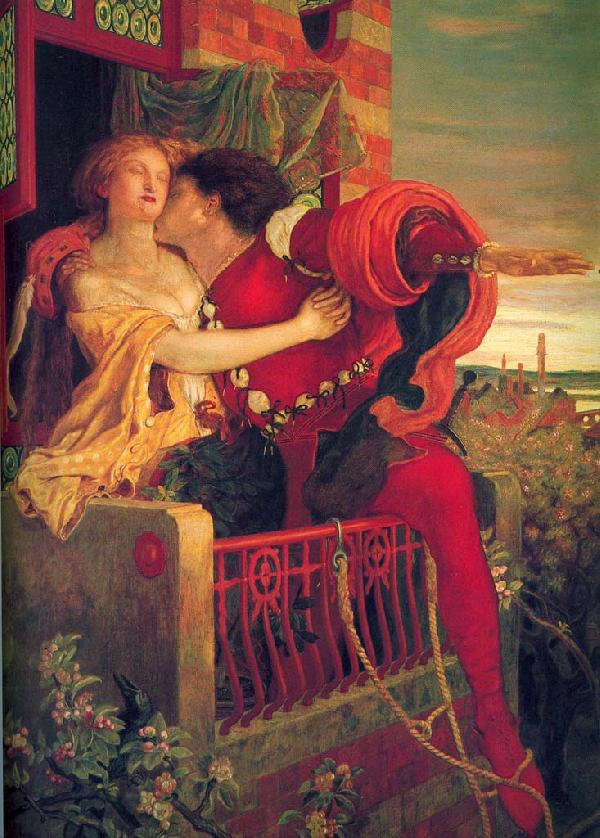
Ford Madox Brown, Romeo & Juliet (1879)
Ultimately, conscious love can and must be an internal concept. The steward and the nine of hearts[8]must love each other to disappear in World 12, the higher emotional center[9], and to engage presence, or self-remembering. In the painting above, the symbolic steward and the nine of hearts are embracing each other. We need to remind ourselves that romantic love is but a faint echo of conscious love.
‘Things as they are, myself as I am.” Rodney Collin[10]
The author has been a student of the Fourth Way for four decades. For other articles in the FourthWayToday magazine by Benjamin, see: https://fourthwaytoday.org/author/benjamin-b/.
[1] Austrian poet (1875-1926).
[2] According to the Fourth way a person has five lower ‘brains’ or centers: instinctive, moving, sex, emotional, and intellectual.
[3] A person working on him/herself.
[4] In the Fourth Way, essence and personality are parts in oneself that are natural and acquired, respectively.
[5] Sufi mystic and poet (1207-1273).
[6] William Shakespeare (1564-1616), from Hamlet.
[7] C influence, or conscious influences, are men and women who have attained immortality in their earthly sojourn. According to a present-day spiritual teacher, the plot of one’s life can be looked at as a play.
[8] The steward is the part in us that can engage presence, or self-remembering. The nine of hearts is the most powerful part in us that can do that.
[9] According to the Fourth Way, a person has two higher centers, higher mental and higher emotional, worlds 6 and 12, respectively.
[10] English spiritual teacher (1909-1956) and student of Ouspensky.