Most people live their lives oblivious to the fact that they are machines. Some reach a point where they begin to feel uncomfortable with their life. They may wonder what it is all for, perhaps realizing that they are asleep. Some may even join a group where ideas about awakening are taught.
One of the basic universal laws introduced by Gurdjieff is the Law of Three. This law states that every phenomenon and every action that leads to a result arises from the interaction of three forces. These are an active force, a passive or denying force, and a mediating force.
This means that the awakening of the higher Self is also the result of three forces. Attempts to awaken on our own involve personal desire and effort, on one hand. But also bring into play the opposing force of our mechanical nature on the other. Still, the third force is missing.
The third force is outside help, and it must come from a higher level.
“The whole idea of school is study based on the experience of other people. Not people such as we are, but people of higher mind. Otherwise there can be no school. If a school is limited only to what we know ourselves, then it is not a school. This means that men who want to change their state of consciousness need a school. But first, they must realize their need. As long as they think they can do something by themselves they will not be able to make any use of a school, even if they find it.
Schools exist only for those who need them, and who know that they need them.” — P.D. Ouspensky
This implies a difference between a gathering of people who share a common aim to awaken and a real school. A real school exists under the guidance of higher forces. It is created through such higher help, while a group is established by one or more people.
The Fourth Way asserts that all major religions were real schools. That is, established under the influence of a conscious source. In real schools, some members are able to attain full awakening.
Only when this connection with the conscious source is lost does ‘religion,’ in the ordinary sense of the word, arise.
“All inspiration and true teaching that ever came to man came from the same circle, the Hierarchy. If people understood that, there would be no more quarrels about different religions, philosophies or customs. Instead, they would begin to reflect the harmony which already exists there, where the Hierarchy works.” — Rodney Collin
A true school is concerned with awakening. Yet it teaches not only methods of awakening, but also that most parts of a person’s being are either indifferent to it or actively opposed to it. Even though these aspects in a person are not real, objectively speaking, they do control a person and create an illusionary identity. People do not have unity, but are a collection of many I’s, each having their own interest. To become aware of this within oneself is essential, otherwise efforts toward awakening remain largely imaginary.
“As soon as a man awakens for a moment and opens his eyes, all the forces that caused him to fall asleep begin to act upon him with tenfold energy. He immediately falls asleep again, very often dreaming that he is awake or is awakening.” — G.I. Gurdjieff
‘The forces that cause a person to fall asleep’ are his own mechanical habits. This mechanicality arises from being educated by people who are themselves asleep. It also comes from unconsciously imitating the mechanical patterns of parents, friends, and those one admires. In contrast, a real school teaches its students how to stop being mechanical and how to truly ‘do.’
“Man is the being who can ‘do,’ says this teaching. To do means to act consciously and according to one’s will.” — G.I. Gurdjieff, Views of the Real World
Acting consciously, according to one’s will, depends on the presence of the higher Self. To sustain this presence—to sustain self-remembering—one uses repeated reminders to not pay attention to or enter into conversation with the ‘I’s that arise in the mind. Since new thoughts appear every three or four seconds, one must renew this reminder again and again. One works to keep attention on the present moment while remembering that one is a soul imprisoned in a machine.
This continual succession of reminders has been called ‘the sequence’ in various esoteric traditions.
“The scriptures say, All things have a source and an end; all events have a beginning and an end. Know this sequence and you will be near the Tao.” — Shui-Chingtzu, Cultivating Stillness (Taoist text)
“We should wage this spiritual warfare with a precise sequence.” — Philokalia, Hesychius of Jerusalem (Orthodox Christian text)
“There is a sequence of steps, which are like entering a path of stepping stones.” — Zhiyi, The Six Dharma gates to the Sublime (Chinese Buddhist text)
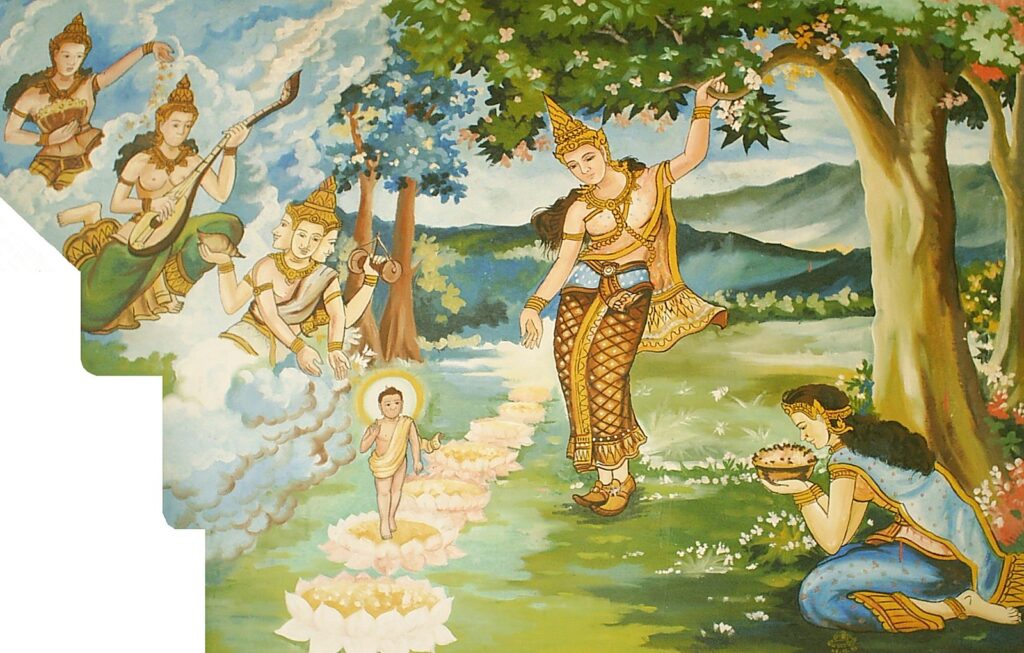
Buddha, taking seven steps right after birth at Lumbini Park; the seventh step represents arriving at ‘non-doing’, from a temple in Laos
This method of ‘doing’ is followed by ‘the method of non-doing.’ This is when the sequence ends and is followed by sustaining self-remembering without any reminders. When students have enough experience and are mature and lucky enough, higher forces may start to grace them with uncreated light. This is the experience in which, without direct effort, one is graced with a prolonged state of divine presence. Many people may unknowingly have had one or two such experiences during their lives. Yet repeated experiences occur only after one has made sufficient effort and the lower self no longer dominates one’s being all the time.
“When man is introduced by the action of God into the world of Uncreated Light, there are no words to express his wonder, no words, no sighs to tell of his gratitude.” — Silouan the Athonite
Uncreated light is a miracle bestowed on people who have been prepared by higher forces. However, the experience is always relatively brief. The lower self is always eager to find a way back in and push one back into the darkness. At those times the sequence is the best tool to bring back created light.
“In right order, you form a magnetic center, you find Influence C, you receive the sequence, and you transcend the sequence with uncreated light.” — Robert Burton
“If a student happens to meet an enlightened teacher, he should first seek the Way of doing, then seek the Way of non-doing, and further seek the Way in which neither doing nor non-doing is established. Only then can the work of cultivating reality reach complete penetration and great awakening.” — Liu Yiming, Cultivating the Tao
It is not uncommon for people who work by themselves, attend workshops from time to time, or belong to groups without conscious guidance to believe that they can experience uncreated light immediately. Because the Tao Te Ching speaks about ‘non-doing,’ and omits the way of ‘doing’, many Taoist practitioners pursue a state of non-doing. It is effortless action—doing what one loves, moving with the flow, and not interfering with or forcing outcomes. However, such explanations often overlook the most important aspect. This is that the state of non-doing is not merely a relaxed or natural way of acting. It is a state in which the presence of one’s higher Self is spontaneously sustained, without any direct effort in the moment.
This is the state of sudden awakening described in Zen Buddhism, where one sees directly into reality. This is the state of non-duality of the Hindu Advaita traditions, in which one sees directly that the world is an illusion created by one’s own mind.
As soon as this state is lost—which inevitably happens—one returns to believing in the illusory world. It is not uncommon that people then, although asleep again, as Gurdjieff remarked, ‘dream that they are awake or are awakening.’ Adopting the attitude that all the world is an illusion is insufficient by itself; one must continually return to the intentional effort of awakening the higher Self. Even in a conscious school, one cannot rely on the grace of higher forces to give one uncreated light. One needs to continue making effort.
“What we call ‘method’ serves to remove faults. If there are no faults, no method needs to be applied.” — Liu Yiming
Here ‘faults’ do not refer to character flaws, but habits and mechanical behavior that keep one’s higher Self in the state of sleep.
“We cannot obtain heavenly bliss through our strength alone, but with the assistance of divine grace.” — Johann Wolfgang von Goethe
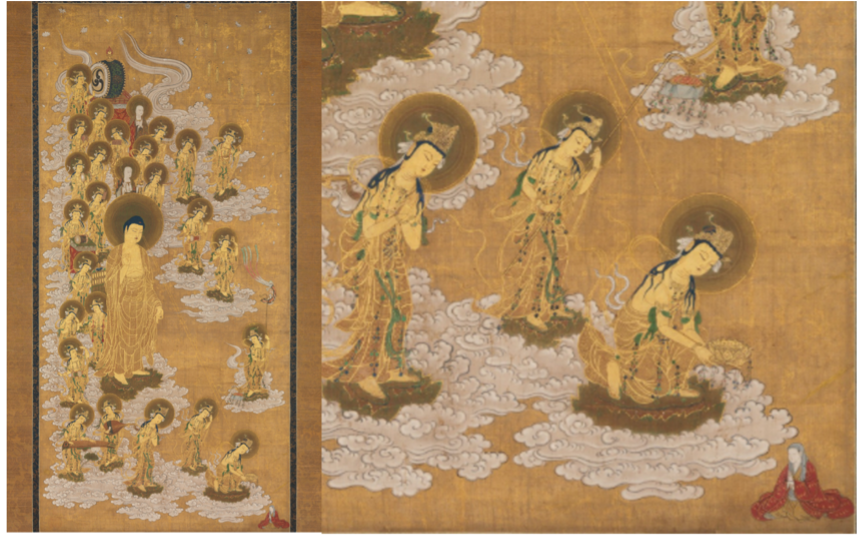
Welcoming Descent of Amida Buddha and Twenty-five Bodhisattvas, 1668, Japan, Metropolitan Museum of Art
Walther Sell has been a student of the Fourth Way for decades. He is the author of a website on Oriental esoteric teachings, Inner Journey to the West. See other articles by Walther for the FourthWayToday.org: Walter Sell articles.