What do we mean by living in “two worlds”?
The second state is the world of the lower centers. Our lower functions: sensations, movement, ideas and theories, and feelings. These all occur with little or no awareness. In this state, the four lower centers react to various stimuli in the environment. In the state of presence, higher centers generate themselves. They inconspicuously generate consciousness and respond, rather than react, to their environment.
Since higher centers reside in the human vessel for the duration of their earthly term, how do these two worlds–lower functions and consciousness–co-exist? Functions can exist without consciousness, and consciousness can exist without functions. So where do the land-locked lower centers meet the profound ocean of awareness?
The work of the steward is to bring the lower centers into relative balance. It prepares them for the emergence of higher centers. Without the effort of non-expressing negative emotions, self-remembering, and transforming suffering, the untamed and uneducated lower centers will continue to usurp higher states. Divided attention, however, brings us to the shores of the third state.
Just like Moses was denied the promised land, or the classical invocation, “Thus far and no further,” the steward cannot partake of higher states of consciousness. In relation to the advent of higher centers, the expression “a law unto itself” serves as a description of the wholly separate nature of consciousness.
At a recent event, I asked an older student whether he still experiences negative emotions. He replied that he is able to see negative emotions, just as he sees the flower arrangement on the table at which we were dining. He clarified this to say that when he sees negative emotions, he goes around them, avoiding them, as it were. Almost without missing a beat, he then stated that this is still a large area for us and that working with the non-expression of negative emotions requires courage.
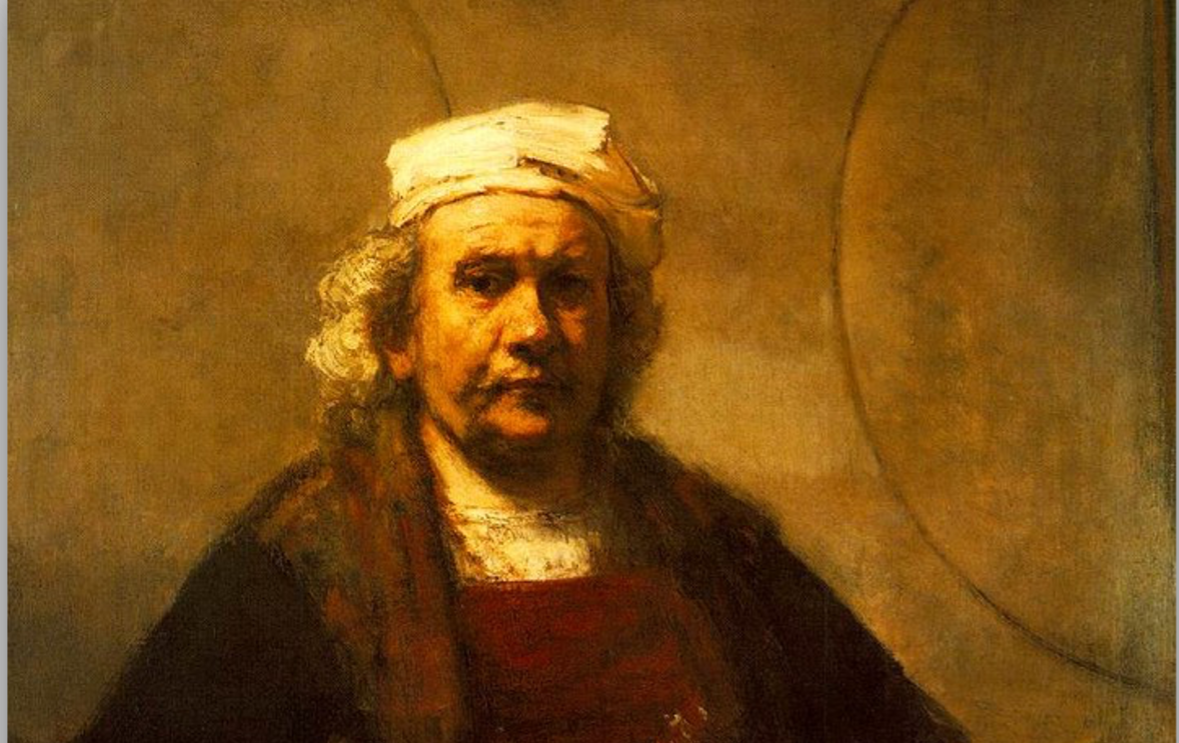
The accompanying image of a Rembrandt self-portrait discreetly includes two circles behind him. Neither one touching the other, yet they are part of the whole composition. It is as if Rembrandt is illustrating that there are two worlds. One, the world of the lower centers, portrayed by the faint, almost ambiguous circle on the left. And the world of conscious reality, that is, higher centers, portrayed by the definite circle on the right. The painting indicates that these two elements exist within the same vessel, as portrayed by Rembrandt himself.
Working in a school along Fourth Way lines involves practices that are critical for conscious evolution. Namely, the non-expression of negative emotions, self-remembering, and transforming suffering. These techniques have been perfected by schools for conscious evolution throughout history. They are still available, and still as necessary.
Charles Robertson has been a student of the Fourth Way for several decades.