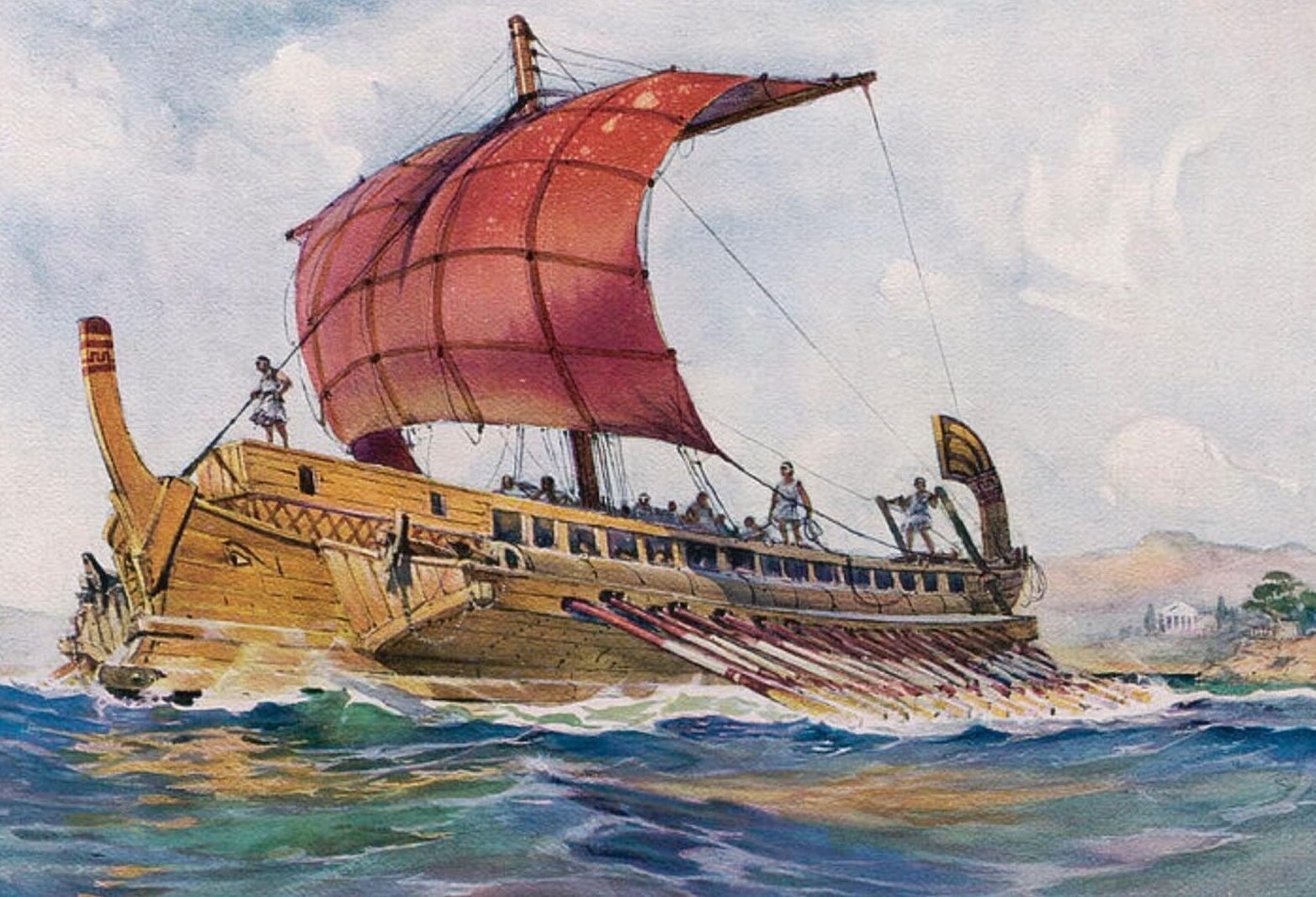
There is a famous Greek paradox known as the Ship of Theseus.
The Greek hero Theseus has a ship that he has sailed on the seas for many years. From time to time, a mast breaks and must be replaced. A worn sail is torn by a strong wind and wood in the stern has to be substituted after hitting a rock. After a time, the moment arrives when there is no longer a single original piece in the ship of Theseus that was present when it was built.
Is it then the same ship or a different ship?
We might compare the analogy with the human body. Since birth, our cells have changed many times. There is certainly no longer a single ‘original piece.’ Furthermore, our thoughts, habits, opinions, and tastes may have changed radically. Is there anything within us that canattest to a continuity of identity, given that all the ‘material’ has changed?
On a physical level, to continue the analogy, we can think of the double helix of DNA. From this perspective, the body is the execution of instructions in our DNA. These instructions dictate the likely trajectory of the body in time, indicating how long we might live and what diseases may take us away. The information it contains is of a higher order than the cells of the body that arise only to be replaced.
For the ship, we can say that its originator or ‘highest order’ is Theseus himself. He built it and hired people to sail and maintain it. But the identity of Theseus is on a higher level than the ship’s material. What material did he use to build it? He used what he had available. If he built it in Athens, he used wood from Athenian trees; if he built it on the island of Paros, he used trees from there.
Perhaps we could describe ‘being’ as the encounter between an original intention and the material available at a place and time.
As in the encounters between Alice and the Caterpillar, Ulysses and Polyphemus, the Lover and the Beloved in Sufi poetry, and others in literature and myth, the Ship of Theseus poses the problem of identity. The question is always: Who are you? Who am I?
And the answer almost always begins with understanding what we are not.
We begin to question living with our sense of identity firmly rooted in what is transitory. Part of our identity is as unreal as the wood of the ship, which will break and decay. We may sense that behind the materiality of life lies something independent, permanent, and inexhaustible.
There is something in us that, like Theseus, entered a forest and chose trees to build our selves. The events and emotions of our lives tempt and hypnotize us. We may attribute more depth to these than they have. What we call ‘life’ is a form of theater— changeable, fascinating, but limited in its reality.
There is a force, sometimes perceptible as a spark within this or that being, that pushes everything and everyone toward something.
Think of those scientific films that show a neuron waving its tentacles, reaching out to find a companion to connect with. Or an underground sprout emerging from a seed, pushing through soil until it finds the light. In that beautiful and poignant documentary, “My Octopus Teacher,” an octopus approaches its human friend. Touching him, the octopus discovers the man’s heart, feels its beat, and leans in to hear it. The heartbeat is more than just a sound; it connotes a source of being. Hearing another’s heartbeat is more like a resonance of souls.
Forms constantly change. The force that shapes the forms we encounter, however, is one and the same. It is awareness. Forms are a product of the incessant pushing of this incorporeal awareness.
Who am I? Our sense of identity depends on what we tune into, whether the material or the maker of the material.
To adopt a description coming from the Hindu tradition, The Field, and the Knower of the Field: I am the Knower, and yet the Field reminds me that I am the Knower. This Awareness grows less tied to the material of my body, and expands to include much more than my name, tastes, desires and opinions.
To tune our sense of identity to what is more real, to remember ourselves, is a process. It has degrees and oscillations.
Alice answers the Caterpillar’s question by saying, “I don’t know who I am, I’ve changed so many times since this morning.”
Ulysses answers the blinded Polyphemus’ question, “Who was that?” “No one.”
And Rumi has the Lover knock on the door of his beloved.
“Who is it?”
“It’s me.”
And the Lover is rejected. Once, twice, three times.
“Who is it?”
“It’s me.” Until the lover understands.
“Who is it?”
“It’s you.”
And the Beloved lets him in.
Sergio Antonio is a long-time student of the Fourth Way and leads discussion groups in Europe and Italy. His recently published writings on work in a school is on Amazon: https://www.amazon.com/Question-Presence-Work-Spiritual-School. For another article on octaves, see: https://fourthwaytoday.org/octaves-and-intervals/.