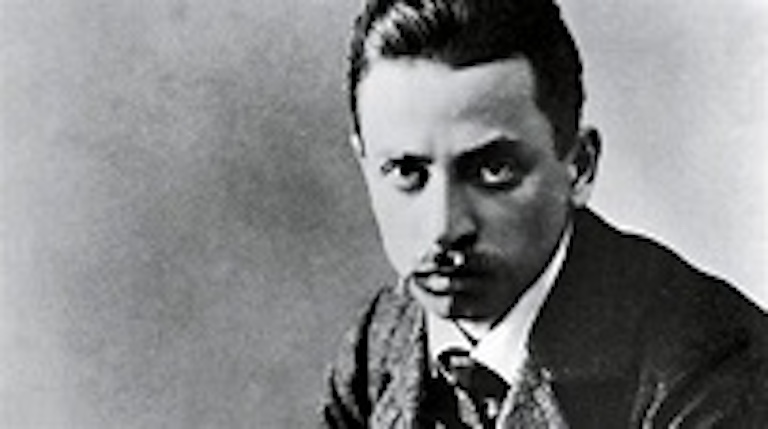
The poet, Rainer Maria Rilke, speaks of a transcendent, inward ‘seeing.’ From one of Rilke’s letters to a friend:
Though you may laugh if I tell you where my very greatest feeling, my world-feeling, my earthly bliss was, I must confess to you: it was, again and again, here and there, in such in-seeing in the indescribably swift, deep, timeless moments of this godlike in-seeing.
Rilke also refers to the use of art in this practice of inward seeing:
[Art is] the preliminary stage for new insights or a kind of transfer to a higher plane of life where there would commence a more mature, greater seeing, a looking with rested, fresh eyes.
He further describes art as “nothing but the means to recapture something entirely invisible.”
Working with trust that higher states are possible, that we have experienced them and may reach them again, is an act of inner faith. Higher states are invisible, until they are upon us. Remembering our verifications, we go on to renew our efforts. One essential step is to drop the imagination and identification that normally surround us. To actually see what is before us, purely, and simply.
See what is before you, and all things shall be added unto you.
– Christ, in the Gospel According to Thomas
Holding trust in what is possible, we find ourselves once again rising to a state we remember well. As T.S. Eliot wrote,
We shall not cease from exploration
And the end of all our exploring
Will be to arrive where we started
And know the place for the first time.
Seeing daily that we are asleep, that we lack will and unity, we return again to inner work. But efforts to return to the present, to recenter our inner work, do not always lead to higher centers. Sometimes we must work blind, making efforts and trusting that we will find our way to a state of understanding.
This trusting blindness is well expressed by the medieval mystical text, The Cloud of Unknowing:
Wheresoever that that thing is, on the which thou wilfully workest in thy mind in substance, surely there art thou in spirit, as verily as thy body is in that place that thou art bodily.
…Reck thee never if thy wits cannot reason of this nought, which may better be felt than seen. For it is full blind and full dark to them that have but little while looked thereupon. Nevertheless, if I shall soothlier say, a soul is more blinded in feeling of it for abundance of ghostly light, than for any darkness or wanting of bodily light.
What is he that calleth it nought? Surely it is our outer man, and not our inner. Our inner man calleth it All.
When it comes to seeing ourselves and our possibilities, we have to believe that a door is open, even when our minds tell us that it is closed.
For more on Rilke’s views on the art of truly seeing, explore these links:
https://www.themarginalian.org/2016/12/14/you-must-change-rilke-rodin-empathy/
https://rilkeduinoelegiestranslations.com/rilke-and-art-under-all-eyes/