
As a contemporary spiritual teacher assures us, essence is more real than personality. Dimensions of essence are one’s center of gravity[1], body type, and alchemy, the degree of refinement of the impressions[2] one takes in. Essence is the part in us that can grow into presence, or self-remembering. Alongside essence, each one of us has a personality, the borrowed part in us, the result of imitation and education.
The function of personality is to shield essence. Essence is more vulnerable than personality. Yet in order to maintain its sensitive, often delicate nature, true personality has to stand guard, as it were, at the door. Another difference between essence and true personality exists in relation to the sides of us that can partake in spiritual growth.
The nine of hearts[3] is the part of the machine that can bring us to the threshold of consciousness, and support presence once it has appeared. The Steward is essentially true personality. It can assist the nine of hearts, and maintain intentional standards. These standards can be conducive to presence. One example that a modern day spiritual teacher gives us is, while dining, to take a sip of water between bites.
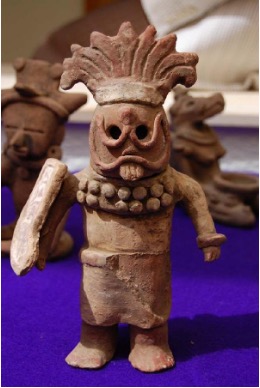

In the images above, a Mesoamerican masked warrior is depicted. The figure can be seen as the Steward. On the right, the mask has been lifted, and a child, with gentle essence predominating, appears.
Many times, however, personality grows of its own accord, and becomes a false personality. As Ouspensky points out, the study of false personality, or the lower self, is one of the best ways to remember one’s self, or be present.
This may be the place to delineate a curiosity of the relation between false personality, true personality, and essence. These entities are discrete, in the sense that one of the three usually predominates[4]. Presence is ‘essence aware of itself,’ as a contemporary spiritual teacher points out. At the same time, between the three there are degrees. It is the job of the Steward to recede once presence has appeared.
“Do not stain with meditation a mind that is already pure.” Buddha
The instinctive center opposes spiritual evolution. As Shakespeare put it, ‘It is a beast, no more.’[5] The intellectual part of the instinctive center, the king of clubs, anchors the lower self and can actively oppose presence.
The king of clubs moves in the shadow of imagination.[6] However, it can become passive, and then presence can appear.

In the World card of the Tarot, a beautiful lady signifies higher states of consciousness. Four figures surround her, one of which is the bull, or lower self. The others are an angel, an eagle, and a lion.[7] These parts in us can aid our efforts to be present, which is why halos crown them. The bull alone does not have a halo—it cannot be present.
“For when I, coming deep down from beasts, longed to be instructed in mankind, behold, the next stage, the Angelic, was infused into me.” – Rilke
[1] Fourth Way authors present the human machine as having four lower brains, or centers—instinctive, moving, emotional, and intellectual. In each person one of the four predominates. This is one’s center of gravity.
[2] Impressions can be of many kinds—music, nature, people arguing, etc.
[3] The nine of hearts is part of the intellectual part of the emotional center, the king of hearts.
[4] For the sake of simplicity, we here group higher states of consciousness with states of essence.
[5] From Hamlet.
[6] Imagination is the incessant churning of unconscious thoughts in our mind.
[7] The angel, eagle, and lion represent the steward, intellectual center, and emotional center, respectively.