In every genuine encounter with art, we are invited into a dialogue between trust and verification: trust in the intuitive resonance that beauty awakens within us, and verification through the attentive discernment that reveals its inner coherence. Great works of art, like great spiritual experiences, ask us not to choose between faith and understanding, but to allow both to coexist in a higher harmony.
Standing before Fra Angelico’s Madonna of the Shadows, in Florence, Italy, we enter such a dialogue. The fresco does not simply depict a sacred scene—it asks the viewer to trust the invisible meaning behind form, color, and light, while verifying that meaning through contemplation and awareness.
Between what appears and what is revealed, the fresco becomes a living metaphor for the path from perception to understanding, from devotion to knowledge.
Experiencing this fresco is an invitation to both trust our intuitive perception of truth, yet to verify its deeper meaning through the attentiveness of the higher state it can bring.
This artwork moves us from the narrative to the symbolic, showing that understanding often requires conscious openness, discernment, and grace. It also reminds us that what we perceive and verify with our physical eyes often differs from what we perceive and verify with the higher mind. Thus, trust and verification may coexist in higher dimensions of being and be necessary to each other—much as science, which relies on verification, is now meeting spirituality, where trust in the mystery is often essential.
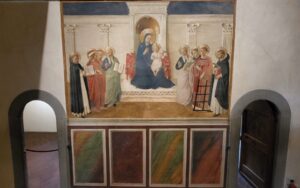
We are in the corridor that connects the friars’ cells to the scriptorium, the church, and the refectory—a passage traversed daily by the friars. Here we find the fresco of the Madonna of the Shadows. The work takes its name from the painted shadows and immediately presents itself as an authentic Renaissance fresco.
It has two parts, upper and lower, and the height of the panels itself suggests its grandeur. The fresco stands well above the doors, dominating the space. Many have interpreted these panels as a simple, incomplete decoration—the skirting of the corridor. However, in a Dominican convent inhabited by poor preaching friars, it would have been unthinkable to enrich the entire corridor with faux precious marbles. Moreover, in this case, Fra Angelico painted the panels himself, while such decorative work was usually entrusted to specialized artisans.
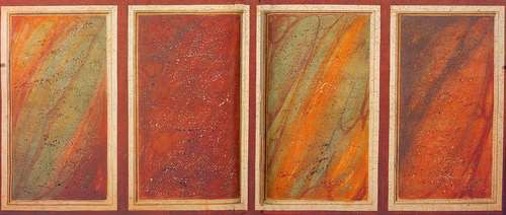
Indeed, these panels are not mere decorations. The veins and splashes visible on their surface, applied when the plaster was nearly dry, recall Jackson Pollock’s dripping technique. This is not a matter of carelessness: the artist did not intend to spoil the fresco with random splashes, but rather to invite the viewer to look beyond— beyond the imitation of marble. The friars passing through the corridor, learned and erudite, immediately grasped the mystery: these panels do not simply represent marble, but something higher, transcending mere mimicry.
What do these four marble panels represent? They are the so-called ‘figures of the dissimilar’—pictorial signs that, beyond their mimetic appearance, lead to a supernatural, symbolic, and theological dimension. These marbles respond to something beyond the simple formal and mimetic decorative intent of the Renaissance: they embody “DECORUM” in the sense described by Thomas of Cîteaux—that is, the true beauty of painting, according to which the word decor derives from Decus Cordis, the beauty of the heart, or inner beauty, as opposed to pulcher, external beauty. In this sense, the marbles incarnate the spiritual decorum of the representation: they are not decorations for their own sake, but tools for meditation, embodying the “true beauty” described by Thomas Aquinas, in which authentic beauty does not lie only in visible harmony but reflects divine order and perfection.
The upper part of the fresco tells the story, the verisimilitude, the event itself: Mary, giving life to Jesus, allowsGod to be with us. This narrative, although not chronological but simultaneous, fosters the flourishing of the human—namely, the Church. In the lower part, the invitation to the friars is clear: to close their eyes to verisimilitude, to mimesis, to the simple imitation of the narrative, to the external meaning, and to open their gaze to the dissimilar, to the mystery, to the inner meaning.
The four colored areas introduce a mystery: the figure of Christ and the connections that lead us to Him. The two main marbles, onyx and jasper, carry precise symbolic meaning: onyx, already in Jewish culture,adorned the vestments of the high priest in the Holy of Holies. And for the medieval Church, they represented Christ—the unifier of diverse peoples and colors into a single community, the Church. Jasper,also called the “stone of blood,” symbolizes Christ’s blood and passion.
These marbles thus become Christological figures.
The panels are positioned before the event itself. Through perspective, they guide the gaze toward the essential. They symbolically represent Christ’s tomb, placed beneath an altar that glorifies the divine maternity and the universal Church. It is not a memento mori, but a tomb that holds the mystery of human salvation. It speaks of the Resurrection, anticipating—or synthesizing—what truly occurred. In Fra Angelico, incarnation, divine maternity, death, and the resurrection of Christ are always interconnected.
The artist first applied the dominant colors with broad brushstrokes, creating a “bed of color,” and then splashed multicolored droplets from a distance once the fresco surface had dried. This gesture obscures imitation and foregrounds the material presence of the pictorial trace. These splashes become pure painting, manifesting their materiality, vitality, and presence.
There is an evangelical meaning in this gesture. In the Gospel of John, sowing and harvesting, though distinct in time, share the joy of the completed work, indicating that the Kingdom is already present. “The reaper already receives wages and gathers fruit for eternal life, so that the sower may rejoice together with the reaper.” (John 4:35-42) These splashes of color can read as a symbolic presence of Christ, disseminated and alive. Fra Angelico thus reveals himself as a “sower” ante litteram—an artist who unites theological contemplation with the materiality of color, spirituality with pictorial gesture, even anticipating techniques and languages of contemporary art.
These painted marbles, with their colors and ‘sown’ gestures resonating with a transcendental presence, invite us to reflect on how personal experience itself can become symbolic—a universal and timeless language of the soul.
This passage from the particular to the universal, from the narrative to the symbolic, seems very much in line with what we do when we extract from, say, a text, an image, or a situation, the Ten Commandments, a square, a circle, uncreated light, etc. This seems to be the hidden and mysterious work of conscious schools.
In this way, Fra Angelico’s fresco mirrors the same inner movement of trust and verification: trusting the invisible meaning beyond appearances, and verifying it through the lived experience of consciousness—a union where faith becomes understanding, and beauty reveals truth.
–Drawn from Fra Angelico, Dissemblance and Figuration by Georges Didi-Huberman, translated by Paolo Peroni, 2022.
Stefania Maggini is an Italian educator and poet living near Florence, Italy, and has studied the Fourth Way for four decades. For an earlier article by Stefania, see: https://fourthwaytoday.org/author/stefania-maggini/.