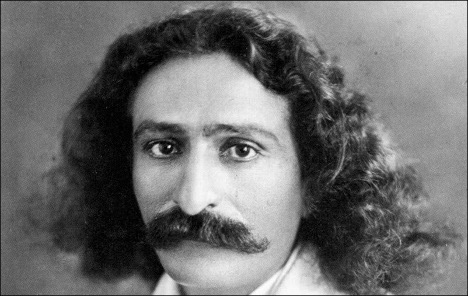
To begin I should make it clear that Meher Baba considered himself an avatar, and that what I have to say here is partially an attempt to understand what that means. In simple terms, an avatar is a god who became a man, rather than a man who, through efforts in his life, evolves into a god.
This does not mean that Meher Baba was born awake. By all accounts, he had a normal childhood and had interests not at all unusual for a teenager. He enjoyed sports, games, and literature, particularly poetry. His father and his grandfather both had a disposition for religion. His grandfather, a Zoroastrian, was a keeper of a dakhma, a tower of silence. These places were set on the outskirts of Persian towns and were where the community brought their dead to be eaten by vultures. Zoroastrians considered this method of disposing of the dead to be safest. They believed that burying the dead polluted the earth and that burning the dead contaminated fire.
Meher Baba’s father, Sheheriarji, grew up helping his father, but at the age of thirteen left to become a dervish monk and traveled in Persia and India. He lived as an ascetic for 10 years before he had a dream where he was told that it was not his fate to achieve enlightenment. Eleven years later he married Shirinbanoo who was to become Meher Baba’s mother. They settled in a town near Bombay. Shirinbanoo was fourteen at the time, and he was thirty-four.
Meher Baba was their second child and was born in February of 1894. His period of awakening began in January 1914, when he was just nineteen. It continued until December 1921, for nearly eight years. It ended when Upasni Maharaj declared that he had made Meher Baba perfect and that he was the Sadguru of his age.
During this eight-year period Meher Baba was helped by five different ‘perfect masters.’ In some cases, Meher Baba only visited these masters, but in other cases he spent time with them. By all reports, the time spent was mostly a silent time.
The story of the beginning of Meher Baba’s awakening is that his first teacher Hazrat Babajan (a woman) kissed him on the forehead. This occurred one evening a year after their first meeting. After the kiss, several hours later when he was home in bed, he ‘lost his body consciousness.’
The first person to discover Meher in this condition was his mother. She found him lying with wide-open, vacant eyes. She called to him, and he sat up. He could not speak. Thinking he was seriously ill, she made him lie down again. For three days he lay in this condition; his eyes were open, but he saw nothing. On the fourth day, Meher began to move about and was slightly conscious of his body. So he remained for nearly nine months. ~ C. D. Purdom (The God-Man)
Purdom describes the next eight years of Meher Baba’s life and his visits to the five perfect masters. He also tells us about Meher Baba’s asceticism. Long hours of meditation, of walking, of fasting, and at one point, beating his head against a stone wall. Purdom doesn’t shy away from describing Meher Baba’s inability to do basic tasks like feeding himself or choosing his clothes. Instead he point them out as if they were evidence of high spirituality. At first, Meher Baba, the avatar of his age, needed to be cared for as if he were an infant. Later, when he was somewhat better, he tried a succession of occupations and failed at all of them.
This story indicates a remarkably different way to how we normally think about the process of awakening. Typically for us, it begins with a greater awareness of what is around us. With a greater capability to negotiate the ordinary world, not the reverse.
In the Fourth Way, awakening is thought of as a linear progression. It goes from lower worlds to higher worlds. We begin by observing our false personality (world 96) and changing the way we look at ourselves. We do this by creating attitudes based on reality rather than illusion. These attitudes represent world 48. We use observation to separate personality from essence (world 24).
Once we find essence, the work of attention and self-remembering begin to create results. Those results are moments of perception from the higher emotional center, (world 12). Meher Baba called this level the subtle body.
Once a disciple is on a solid footing with the the higher emotional center, he can glimpse the higher intellectual center (world 6). In reality, all levels are possible to experience at any time on the way. Yet to awaken in the midst of ordinary life, this bottom-up approach may seem a more reliable and invisible way.
What we see with Meher Baba’s journey is more of a top-down awakening. The shock administered by Hazrat Babajan appears to have vaulted Meher Baba directly into the higher intellectual world. For a man whose being is squarely in world 6, using Gurdjieff’s diagram, the highest possible for him to experience is world 1 (the Absolute). More revealing is that the lowest world he can experience is world 24 (essence). Ordinary mind works with either world 96 or 48. This may explain why Meher Baba couldn’t speak at first and had trouble caring for himself. His difficulty in navigating the physical world was because he had only a tenuous relation to that world.
I do not think that this top-down awakening is singular to Meher Baba or to the avatar. When an aspirant sets out on a path of transforming intense suffering from the start, he can bypass the subtle world. He can jump directly to an experience of the higher mental or intellectual center. This kind of awakening appears in the lives of Christian saints like Saint Anthony, Saint Francis, or Simeon Stylites.
When suffering is so intense that the physical body believes it will die, the soul takes refuge in the higher intellectual center. This is a natural reaction, because the mental world is the first stage of the afterlife experience. This is a precarious path, fraught with dangers on many different levels. It requires the aspirant to detach himself sufficiently from the physical body. Otherwise, there is a risk of binding himself further to the gross world. This makes spiritual advancement more difficult, if not impossible.
That Meher Baba was able to find himself in the mental world from a kiss indicates that Hazrat Babajan was a powerful spiritual master. It also indicates that Meher Baba had an extremely receptive and ancient soul. His intense early asceticism continued to shock his body, to maintain an existence on the mental plane. In an ordinary man, being thrust into the higher mental center could cause unconsciousness or extreme confusion and fear. His only concern would be to return to normal consciousness as soon as possible.
If Meher Baba achieved the highest level possible in an instant, why did it take him eight years to become perfect? In Purdom’s account:
By the following year, 1921, Meher …could do ordinary acts, speak in a normal way, and understand what was said to him. ~ C. D. Purdon (The God-Man)
At the conclusion of Meher Baba’s visit with Upasani Maharaj, Purdon writes, Meher Baba returned to full normal consciousness.
With his top-down awakening. Meher Baba’s journey was not toward God, but man. After taking possession of the mental body, he had to learn to inhabit the subtle body. This is the world beneath the mental body. Without a connection to the subtle body, he could teach only those who were open to the energies of the higher mental center. At any time, this would not be more than a handful of people.
To appeal to a larger number of people, he would have to connect to them through his subtle body and be able to understand the obstacles to overcoming the illusions of physical existence. For this, he had to achieve mastery over all three bodies, the gross, the subtle, and the mental. He just did it in reverse order. Most aspirants begin with the mastery of the physical body. Then they move the subtle world, and eventually to the mental world, if they make it that far.
Awakening is a process subject to laws. The avatar awakens to a fully evolved soul. Yet all our little awakenings connect to a larger being that contains experiences and impressions veiled to us while we identify with the physical world. In our case, we must for now settle for partial glimpses of what awaits us.
The highest is latent in everyone, and has to be manifested. ~ Meher Baba
After becoming perfect and attracting his own students, Meher Baba created a teaching of a more traditional kind. He did not normally require asceticism from his students. He did not vault them into worlds that they were unprepared to negotiate, as he emphasizes in The Discourses and God Speaks.
Perhaps his choice to remain silent for the last 44 years of his life suggests he had a preference for remaining unhindered from the subtle and gross worlds. Maybe he realized that he had done all he could for humanity without speaking further.
In the Discourses, when he speaks about the day when he will break his silence, he adds:
I bring the greatest treasure that is possible for a man to receive—a treasure that includes all other treasures, that will endure forever, that increases when shared with others. Be ready to receive it.
He left us much, the question for us is: are we ready to receive it?
This article is from William Page, a prolific writer of Fourth Way ideas. This article was first published on his website BePresentFirst.org. For more of his articles in FourthWayToday.org, see: https://fourthwaytoday.org/author/william-page/.